Ford launched the Ranger Double Cab 2-Seat in April 2026. It looks like a normal double cab from the outside, it has four doors, and behind the front seats there is nothing but a load floor. Owners start asking about rear seats roughly a month after delivery, usually the first time somebody needs a lift.
What Ford actually does to the 2-Seat
This is the part most people get wrong, including a fair bit of the press coverage. Ford does not simply leave the back seats out of the box. The 2-Seat is a proper conversion carried out before the vehicle reaches you, and it involves four separate changes.
- The rear bench is removed entirely
- The rear seatbelts are removed
- The rear side windows are blanked off
- A fixed bulkhead goes in behind the front seats, along with a lined load floor and heavy duty anchor points
Ford describes the rear seats as permanently removed, and that wording is deliberate. It is the basis on which the vehicle is treated as a commercial rather than a car, which in turn is the whole reason the 2-Seat exists and the reason it sells.
The rear glass is still there. Ford blanks the windows off rather than removing the glass and welding in a panel. That matters, because the vinyl can be stripped back off, which is a far smaller job than starting from a hole in the door. We offer that as an option on top of the conversion rather than as part of it.
So can the seats go back in?
Yes. The vehicle underneath is still a Ranger Double Cab, and the important structure is untouched. Critically, the original seatbelt mounting points are still in the shell where Ford left them, which means a converted vehicle can carry three proper three point belts anchored exactly where the factory intended, rather than to brackets somebody has invented.
What you cannot do is buy a bench off a shelf and bolt it in over a weekend. The bulkhead has to come out, the load floor has to come out, the belts need fitting to those factory points, and the whole rear cabin needs trimming so it does not look like an afterthought.
What the conversion involves, step by step
| Stage | What happens |
|---|---|
| Strip out | The bulkhead behind the front seats comes out, along with the load floor and lining Ford fitted in the rear. |
| Rear windows | Optional. We can strip the vinyl back off the rear side windows, quoted on inspection. |
| Bench seat | A bench built specifically for this vehicle goes in, trimmed to sit against the Ranger's own interior. |
| Seatbelts | Three 3-point belts fitted to the original factory mounting points. |
| Trim and check | Panels, fixings and finishing, then everything is checked before the keys go back. |
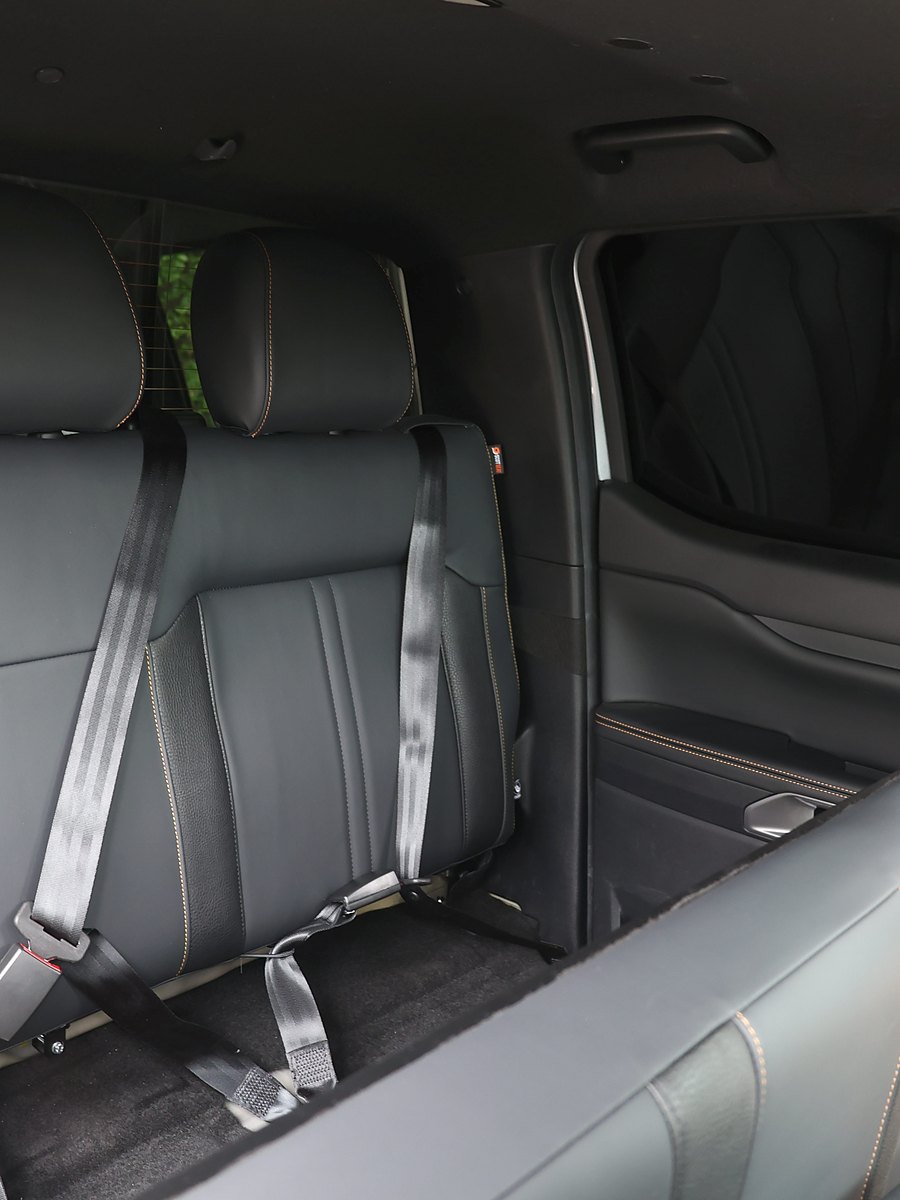
The fold-out mini-bulkhead
One thing worth understanding, because it is different from a normal rear seat. The backrest is fixed. What moves is the seat base, which unfolds to form a mini-bulkhead behind the front seats. When you are carrying a load rather than passengers, you still get a barrier rather than an open cab, which is closer to how Ford intended the load area to be used in the first place.
What it costs
A full conversion, supplied and fitted, is from £2,995 plus VAT, which is £3,594 including VAT. That covers the bench, three 3-point belts, all trim and fixings, and the fitting itself at our Chelmsford workshop. Rear window vinyl removal is quoted separately on inspection. A full VAT invoice comes as standard.
Be wary of anything dramatically cheaper. The cost in this job is the labour and the belt engineering, not the seat, so a quote well under that number usually means corners somewhere you would rather they were not.
The tax question, answered straight
This is the part nobody wants to put in writing, so here it is.
The Ranger 2-Seat is treated as a commercial vehicle because it has no rear seats. That is the entire basis for the flat rate van benefit in kind treatment and the capital allowances position that make it attractive. Putting seats back in is therefore not a neutral change. It may affect how HMRC views the vehicle, and it may also affect your lease or finance agreement and your insurance.
We will tell you exactly what has been fitted, in writing, with the paperwork to go with it, so you and your accountant have something solid to work from.
We will not tell you that you can have the seats and keep the tax treatment with no questions asked. Anyone who does is risking your money rather than theirs. Speak to your accountant before you book.
What about insurance?
Tell your insurer. A conversion that changes the seating capacity of a vehicle is a material fact, and it is a five minute phone call rather than a problem. Owners in the Ranger groups raise this regularly and they are right to: an undeclared modification is the kind of thing that gets picked over after an incident, however minor.
Can it be reversed?
Not in the way a Defender conversion comes out. On a Defender the rear seats unbolt and the vehicle is back to standard in an afternoon. The Ranger is a bigger job, because the bulkhead and the load floor have to come out and the rear cabin is trimmed afterwards. Going back to 2-Seat spec means reversing all of that and refitting the parts Ford supplied, so keep hold of them. It can be done. It is not a quick swap, and anyone who tells you otherwise has not done one.
Which Rangers does this apply to?
The Ford Ranger Double Cab 2-Seat, 2026 onward. It launched in Wildtrak trim, with Ford indicating further trims including XL, XLT and Platinum to follow. If you are not sure what you have on order, send us the spec and we will tell you.
How long does it take, and where?
We are fitting at our workshop in Chelmsford, Essex. Pro-Van has been converting commercial vehicles and Land Rover Defenders back to rear seating for years, and the Ranger work runs the same way. The first Ranger conversions were completed in September 2026 and we are booking now.
If you are a Ford dealer selling 2-Seats and fielding this question at the point of sale, we would like to hear from you. It is a conversation worth ten minutes.